-
Start date
23/07/2011T22:00:00
-
End date
07/07/2025T22:00:00
-
Image
-
Publish in core platform
No
-
URL
-
Link text
Official website of the Student Festival of Digital Creation
-
Link Type
Organization url
-
Target audience
Digital skills in education.Digital technology / specialisation
RoboticsDigital skill level
BasicGeographic Scope - Country
GreeceIndustry - Field of Education and Training
Education not further definedTarget language
Type of initiative
National initiative
Event setting
Type of Funding
Public
Organization
Greek Ministry of Digital GovernanceSkip to content

Malta Digital Skills and Jobs Platform (LISP)

Description
The Greek Student Festival for Digital Creation (www.digifest.info) has been a multi-year initiative since 2011 that promotes students’ creativity through Informatics, transforming them from consumers of digital products into creators. Organized by IT teachers with the support of the Ministry of Education, regional services and local government, it is the largest student creativity event in Greece, with the last one taking place last May 2025. The Festival is non-competitive, non-profit and encourages students of all levels (Primary, High School, Lyceum) to present digital works that express their ideas and propose solutions to problems through technology.
Purpose and Benefits
This student meeting aims to:
- the promotion of the creativity of students and IT teachers and the presentation of their digital works to peers, teachers, parents and local / wider society,
- informing and disseminating learning activities, which foster creativity and all-round learning through work plans and practical problem solving; and
- the communication of the members of the school community (students, teachers, parents) with each other and with the wider local and wider society.
The non-competitive nature of the Festival and its emphasis on creativity make it a model for educational initiatives that promote digital skills and participation. At the same time, its non-profit character is locally controlled and supported by supporters of local communities and economies, adding further value to the decentralized model of disseminating public policies (regional services of the Ministry, local government, etc.).
Innovation and Methodology
The Festival incorporates modern educational methods, such as exploratory learning, the Project method and learning through art, amid other proposed educational methods that promote creativity.
Students collaborate in groups, developing horizontal skills (cooperation, communication) and presenting at events in many Greek cities their projects, which were created:
- in the context of Computer Science courses of all levels (Elementary, High School, General and Vocational Lyceum),
- in the Skills Laboratories of Primary and High Schools,
- the Creative Activities Zone of EPAL, but also
- in the context of a school activity (Environmental, Cultural, Health Education, etc.), national or European educational program, group or in the context of an interdisciplinary / interdisciplinary project of cooperation between the course of Informatics and other courses.
Results and Impact
The Festival cultivates high-level digital skills, enhances students’ self-confidence and promotes innovation. It opens schools to society, promoting the work of students and teachers, while encouraging youth empowerment and entrepreneurship. It also enhances the dissemination of good practices and cooperation between schools, scientific bodies and local communities, contributing to raising awareness of the importance of Information Technology.
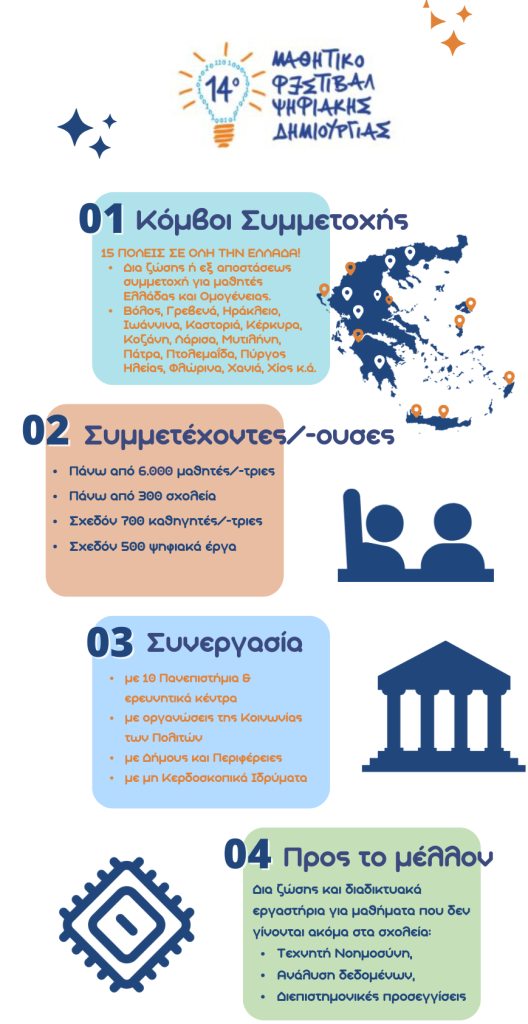
For example, in May 2025, atthe 14th Student Festival for Digital Creation, 6,125 students from 303 schools, led by 698 primary and secondary school teachers, presented 491 projects in 14 cities.
“It is estimated that a total of 4,500 digital works have been produced by students from all over Greece since the beginning of the Festival.”
Academic institutions and research centres also participate with interactive presentations and workshops, strengthening the connection between school, society and the scientific community.
Elements of the works especially from Heraklion, Crete, the birthplace of the Festival, for all festival years, can be seen at ira.digifest.info.
Examples of projects:
- Microbit robotics and mind+ automation: creation of a robotic vehicle with navigation through programming and temperature sensor (5th Primary School of Maroussi – 6th Primary School),
- A museum otherwise…: a different museum with automation (anti-theft system, automatic bins, lights, etc.) and Augmented Reality to augment images after scanning them by a mobile visitor (1stPrimary School of Archanes, Crete – 6th Primary School),
- The 12 Gods of Olympus: creation and presentation of an alternative scenario for teaching the Gods and Goddesses of Olympus section (56th Primary School of Heraklion, Crete – 3rd Primary School),
- BrickBot’s major rescue operation: robotic construction – rescuer to find people trapped in debris after a seismic event (20th Primary School of Heraklion, Crete – 5th Primary School),
- Microbit programming: robotics and STEM equipment to create a string of student names, a flashing heart and a sunbeam in the middle of another programme,
- Smart trains: robotic construction of LEGO automatic train parking at stops and exclaiming the names of stops, but also avoiding train collisions based on colour recognition (9th Primary School of Ano Liosia, Attica – 6th Primary School),
- Smart Pedestrian Passage for People with Disabilities: construction of a smart pedestrian crossing to facilitate people with disabilities using BBC micro:bit, Lego Wedo, Gigo kit and automation (1stPrimary School of Arkalochori, Crete – 6th Primary School).
Why it’s a “good practice”
(i) Massive, longitudinal participation
– Constantly over 6 000 pupils per year,
– Participation of many cities as participation hubs with nationwide coverage,
– Participation of all levels of education without competitive stress.
ii) School-Society-Market Connection The
Festival brings together students, teachers, universities, municipalities, IT professionals and NGOs through workshops, demos and live-streaming.
iii) Open methodology & scalability
– Based on project-based learning, critical making and open-schooling,
– A statute has been in place since 2018 allowing any Regional Directorate or school counsellor to open a new local hub.
More than
500 digital projects per year (appprototypes, robotic solutions, VR/AR, etc.) transform students from users to creators, cultivating digital skills and entrepreneurial culture.
(v) Inclusive model
– Free, non-profit, open to public and private schools,
– Emphasis on inclusion (e.g. web accessibility for people with disabilities, digital works on remote islands).
The ‘Student’s Moving Festival’[1]
With its statutes of June 2018, the structure of the Student Festival for Digital Creation allows it to be easily adapted and conducted in other cities, potentially even in other countries. The Festival’s creators characteristically stated that the term “participation hub” refers to any point, either natural, e.g. city (if the Festival is held in person in that area) or virtual (if the Festival is held remotely for schools from all over Greece and the Greek Diaspora)in which each group of students presenting a work at the Festival is hosted or connected respectively.
The Festival takes place simultaneously at all the participation hubs, examples of which are: Volos, Grevena, Heraklion, Ioannina, Kalamata, Kastoria, Corfu, Kozani, Larissa, Mytilene, Patras, Ptolemaida, Pyrgos Ilias, Florina, Chania, Chios.
Thus, through specific structures/services of the Ministry of Education and collaborations with educational and local bodies, the Festival can be organized in other locations with a priority coordinator being a member of the central committee of the Festival or an IT teacher interested in taking the initiative.
For more information please redirect to the Festival’s website or to the initiative’s contact details.
[1] The title is a play on the famous 2004 Japanese animated film "The Moving Castle of Howle" by Hayao Miyazaki © Studio Ghibli, Inc.