-
Link Type
Organization url
-
Image
-
Publish in core platform
Yes
-
Target audience
Digital skills for allDigital technology / specialisation
Digital skills Web DevelopmentDigital skill level
Basic Intermediate AdvancedGeographic Scope - Country
Non-EU MaltaIndustry - Field of Education and Training
Generic programmes and qualifications not further defined Basic programmes and qualificationsType of initiative
Local initiative
Type of Funding
Public
Organization
Malta Communications AuthoritySkip to content

Malta Digital Skills and Jobs Platform (LISP)

As digital services become the primary gateway to information, communication, and public services, ensuring that websites and applications are accessible to all users is no longer optional—it is essential. Web accessibility is the practice of designing and developing digital platforms so that everyone, including persons with disabilities, can perceive, understand, navigate, and interact with online content. Beyond the technical requirements, accessibility is fundamentally about inclusion and enabling equal participation in an increasingly digital society.
In Malta, the Web Accessibility Initiative is a collaborative partnership between the Malta Digital Innovation Authority (MDIA), the Malta Communications Authority (MCA), the University of Malta (UM), and the Foundation for IT Accessibility (FITA). Launched in 2023, this evolving effort promotes inclusive digital design across the public sector. The initiative supports service providers and content managers in building and maintaining platforms that cater to diverse needs, regardless of a user’s ability, device, or mode of interaction. This reflects a broad commitment to ensuring that Malta’s digital transformation remains human-centred.
Training and Capacity Building
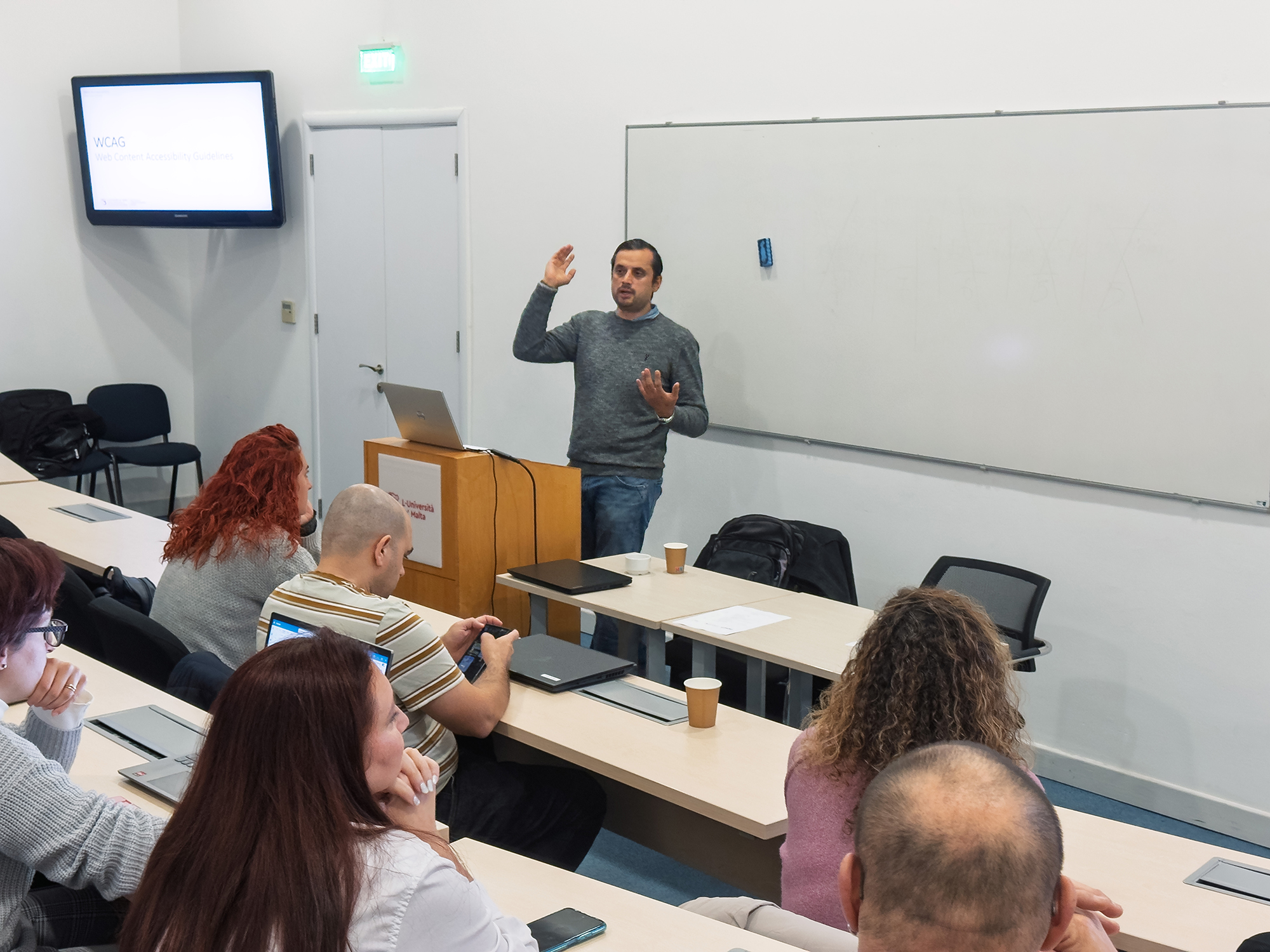
A core component of this initiative is the delivery of specialised training workshops for public sector service providers. These sessions entitled “Web Accessibility in the Public Sector – Principles and Practices” are intended to equip participants with both the conceptual understanding and the practical tools needed to implement accessibility throughout the entire lifecycle of a digital service. Notably, workshops held in November and December 2025 provided in-depth guidance on designing and developing inclusive online services.
These workshops were led by Prof. Chris Porter, an IAAP-certified Web Accessibility Specialist and academic at the University of Malta’s Faculty of ICT. Through a structured, hands-on approach, participants explored core principles such as universal and inclusive design. They also gained valuable insight into how assistive technologies and user agents function, learning firsthand how different users navigate digital platforms. Complementing this technical deep-dive, the Malta Communications Authority (MCA) presented on the Web Accessibility Directive, while The Foundation of IT Accessibility (FITA) provided expert perspectives on the broader IT accessibility landscape.
Technical Excellence and Standards
From a technical standpoint, the training emphasised semantic HTML as the bedrock of accessible web development. Participants were guided through widely adopted guidelines, including the Web Content Accessibility Guidelines (WCAG) and the WAI-ARIA (Accessible Rich Internet Applications) technical specifications. These frameworks ensure that digital content is content is perceivable, operable, understandable and robust.
The sessions also focused on developing effective testing strategies to ensure accessibility is embedded in ongoing quality assurance, rather than treated as a final “check-box” exercise.
Universal Benefits
The initiative highlights that web accessibility benefits everyone, not just persons with disabilities. Features such as keyboard navigation, captions, consistent layouts, and adaptable interfaces improve the experience for all users. For instance, subtitles help those in noisy environments, while audio alternatives assist users who are multitasking. By adopting these practices, organisations can reach a wider audience—including the estimated 130 million people in Europe living with some form of disability.
The urgency of this work has been underscored by the post-pandemic world, where access to healthcare, banking, and education has shifted online. Without accessible design, significant segments of the population risk being excluded from fundamental services.
Legal and Strategic Impact
The Web Accessibility Initiative aligns with a robust European legal framework. It supports the implementation of the Web Accessibility Directive (EU) 2016/2102, which mandates accessibility for public sector websites and apps, transposed into Maltese law via S.L. 418.03. More information about Malta’s role in the Web Accessibility Directive can be found at https://www.mca.org.mt/webaccessibility. It also complements the European Accessibility Act and reinforces rights established under the EU Charter of Fundamental Rights and the UN Convention on the Rights of Persons with Disabilities (UNCRPD).
The impact of the initiative is three-fold:
- National: It strengthens the capacity of the public sector to deliver inclusive services, increasing citizen trust and digital adoption.
- Societal: It reduces digital exclusion, promoting independence and equal opportunity for vulnerable groups.
- European: It aligns with the European Digital Decade goals, serving as a replicable model for other Member States looking to translate accessibility policy into concrete action.
Conclusion
Malta’s Web Accessibility Initiative represents a forward-looking approach to digital transformation. Combining policy, technical training, and awareness ensures that accessibility is a core component of design. As digitalisation continues to shape our lives, such initiatives are crucial for ensuring that the benefits of technology are available to everyone, leaving no one behind.