-
Start date
19/06/2024T22:00:00
-
End date
19/06/2025T22:00:00
-
Image

-
Publish in core platform
No
-
URL
-
Link text
The Lyceum Project
-
Link Type
Organization url
-
Target audience
Digital skills for allDigital technology / specialisation
Artificial IntelligenceDigital skill level
BasicGeographic Scope - Country
GreeceIndustry - Field of Education and Training
Information and Communication Technologies (ICTs) not further definedTarget language
Type of initiative
National initiative
Event setting
Type of Funding
Public
Organization
Lycée des Arts et Métiers (LAM)Skip to content

Malta Digital Skills and Jobs Platform (LISP)

A new generation grows up with – and possibly from – Artificial Intelligence. This new reality makes it imperative to recognise significant new opportunities, but also to address critical challenges. In the age of digital transformation, age-appropriate approaches and designs are essential.
In the same context, the conference initiative The Lyceum Project was developed, with its inaugural kick-off taking place in 2024 in Athens. The basis was a new working document “Lyceum Project: AI Ethics with Aristotle” by the Director of the Oxford Institute of Ethics of Artificial Intelligence, John Tasioulas, and Stanford Professor Josiah Ober: an Aristotelian, ethical framework to address the key challenges and opportunities created by the rapid development of Artificial Intelligence (AI) technologies.
The philosophy is that children should be equipped with the skills and tools to thrive in the digital world and become active democratic citizens. Parents, carers and teachers need to be trained to take into account the impact on children’s life, reputation and future when using AI.
But who is this Aristotle and what does he want with AI?
The working document (‘LyceumProject: AI Ethics with Aristotle’,on which the initiative was based, has as its central thesis that the basic approach to ethics developed by the Greek philosopher of the 4th century BC, Aristotle, offers the most convincing framework for addressing the challenges and opportunities of AI today.
Some central themes of the text included the views that:
- AI ethics must be based on a rich understanding of human bliss, focused on the exercise of particular human abilities;
- AI systems must be understood as ‘smart tools’ enabling individual and collective well-being, and not as beings with a comparable moral standing to humans
- the key political mechanism to ensure that AI serves the human good is to subject it to informed and participatory democratic control, with AI tools potentially having an important role to play in facilitating democratic consultation and decision-making on a large scale.
You can find the full text here.
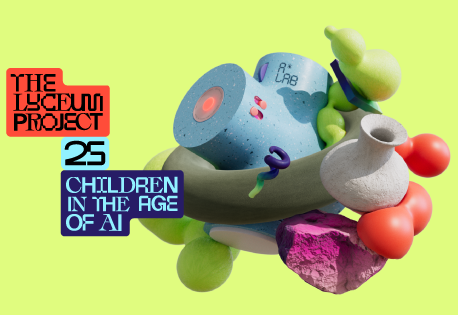
On June 20, 2025, the Lyceum Project 2025 was organized for the second time with the main theme: Children in the Age of Artificial Intelligence. An initiative for a global, open and interdisciplinary dialogue linking philosophy and Artificial Intelligence”looking for answers to a vital question: How can we empower children, the citizens of tomorrow, to thrive in the age of artificial intelligence?
The event brought together more than 500 Greek and international representatives from academic fields, business, healthcare, politics and government, as well as members of Greek society. Greek Prime Minister Kyriakos Mitsotakis addressed and expressed support for the organisation of an annual global AI ethics conference in Athens.
The Lyceum Project 2025 in detail:
The program of the Lyceum Project 2025 conference included, among other things, extremely important themes, such as:
- Returningto Children in Childhood: A balance between rights and protection in the age of artificial intelligence”with Kyriakos Mitsotakis, Prime Minister of the Hellenic Republic, Baroness Beeban Kidron, Member of the House of Lords (UK Parliament) and Dr. Ing Konstantinos Karachalios, Strategic Advisor to the IEEE Executive Director.
- “Childrenand Artificial Intelligence: Empowering the new generation”with Ms. Eugenia Bozou, Head of Government Affairs & Public Policy, Google Greece, Cyprus & Malta.
- The ‘Governance of AI’ panel explored how regulation, ethical foresight and legal responsibility need to evolve to protect children in the age of AI. The following were involved:
- Dr Wayne Holmes, Professor of Critical Studies in Artificial Intelligence and Education (University College London),
- Mr Juraj Čorba, Head of Digital Regulation and Governance (Slovak Ministry of Informatics),
- Mr Alpesh Shah, Managing Director IEEE Standards and
- Professor Ms Lilian Mitrou of the Department of Information and Communication Systems Engineering (University of the Aegean).
- Educationand training in the field of Artificial Intelligence: Empowering Future Generations”with Ms. Tania Perelmouter, Co-Founder and Director of Strategy, Fondation Abeona and Dr. Leda Arnelou, Institute of Informatics and Telecommunications (NCSR “Demokritos”).
- The AIand Educationpanel included:
- Professor Zoe Gavriilidou (Democritus University of Thrace),
- the Epic. Professor Spyridon Doukakis (Ionian University, President of the Institute of Educational Policy),
- Dr. George Kosteletos (National and Kapodistrian University of Athens),
- Mr Christos Skarkos (Director of the Primary School of Vivlos in Naxos) and
- Professor Despina Karakastani (University of Peloponnese).
The discussion focused on the role of AI as a supportive tool in teaching and learning, but also on the need for education to be adapted in a way that effectively empowers children.
“At a time when technology is changing everything, we need to restore interdisciplinarity and the connection of lessons with everyday life,” he said. Prof. K. Sp. Dukakis
- “Whatis the role of education in the era of anthropomorphic artificial intelligence?” (i.e. AI, which mimics human characteristics, behaviors and forms of interaction) with Panagiotis Pantazakos, Professor of Philosophy (National and Kapodistrian University of Athens).
- This was followed by the panel on “Adequateage AI design”. The following were involved:
- Cf. Prof. David Bickham (Boston Children’s Hospital),
- Dr. Jun Zhao (Pan. Oxford),
- Dr. Sergio Imparato (Pan. Harvard),
- Ms Liz Thomas (Microsoft) and
- Dr. Mhairi Aitken (The Alan Turing Institute)
They
discussed how AI can be developed to meet the needs of children and their caregivers, with a focus on the close link between research and innovation. As noted by dr. Zhao: Wewant to put children at the heart of the design process, listen to their voices, respect their needs.
It is worth mentioning that the conference included the announcement of five (5) winners of the Panhellenic Student Competition “Growing up in a World with Artificial Intelligence”, which invited students to reflect creatively on life with AI and gave the opportunity during the event to present fifteen (15) student projects.
Why is it good practice?
The Lyceum Project, the conference on the ethics of Artificial Intelligence from the perspective of Aristotelian philosophy, is a good practice for the following reasons:
- is linked to the ‘Declaration on Inclusive and Sustainable AI for People and the Planet’, signed at the AI Action Summit in Paris in February 2025, to promote inclusive and multi-stakeholder dialogues and collaborations in AI governance;
- fulfils the role of one of the Flagship Programmes under the “Action Plan for the Transformation of AI in Greece”;
- serves as a venue for an annual high-level global meeting on AI ethics and policies;
- is a global, open and multidisciplinary initiative linking philosophy and Artificial Intelligence, coming to life every year on 20 June;
- organized by leading academic institutions, research centers and global organizations,
- bridges timeless philosophical wisdom with AI innovation;
- contains a multitude of topics related to the diffusion of advanced digital skills to all;
- it can be adapted and implemented by other Member States on the basis of their own national philosophical ethics, history of values and philosophical considerations.
Video speeches of the conference can be watched on the official YouTube channel of the Lyceum Project as well as find all the necessary details on the official and mobile accessible website of the initiative here.