-
Image
-
Publish in core platform
No
-
URL
-
Link text
Pioneers in Artificial Intelligence
-
Link Type
Organization url
-
Target audience
Digital skills for allDigital technology / specialisation
Artificial IntelligenceDigital skill level
BasicGeographic Scope - Country
GreeceIndustry - Field of Education and Training
Social work and counsellingTarget language
Type of initiative
National initiative
Event setting
Publication type
General guidelines Unpacking Place Transformation September 18, 2026
 ILO: Changing landscape of skills in the age of AI September 11, 2026
Study supporting the review of the Digital Decade policy programme September 11, 2026
Lifelong learning and skills for the future August 14, 2026Skip to content
ILO: Changing landscape of skills in the age of AI September 11, 2026
Study supporting the review of the Digital Decade policy programme September 11, 2026
Lifelong learning and skills for the future August 14, 2026Skip to content

Malta Digital Skills and Jobs Platform (LISP)

The ‘Leadersin Artificial Intelligence for People with Disabilities’programme is a groundbreaking initiative launched about a year ago (2024) by the non-profit organisation Science for You – SciFY, in collaboration with the Centre for Children and Adolescents and other organisations supporting persons with disabilities. This project, supported by the John S. Latsis Public Benefit Foundation and METLEN Energy & Metals, has already yielded encouraging results, offering new job prospects to people with autism and mental disorders.
Objective and Innovation of the Program
For the first time, a highly innovative way of employing people with disabilities has been studied in the light of emerging technologies. The program aimed to integrate people with disabilities into the fast-growing field of Artificial Intelligence by training them in tasks related to annotation, a critical process for educating Artificial Intelligence systems through informed learning. This work, which requires attention to detail and repetition, is considered particularly suitable for people with specific forms of disability, such as autism. At the same time, the program takes into account the special training needs of people with disabilities, while emphasis is also given to the preparation of employers.
Education and Employment Process
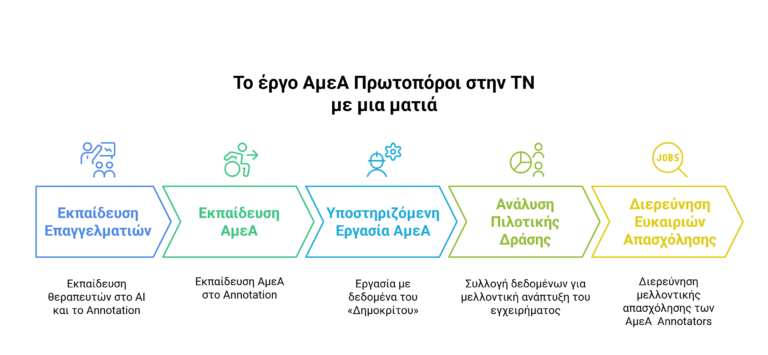
The implementation started with the training of professional therapists in Artificial Intelligence and annotation, in order to be able to transmit their knowledge to people with disabilities.
Twelve participants were then selected (7 with autism and 5 with mental disorders), who were trained for three months in various types of annotation (sounds, music, text, images). The results showed that people with high functionality responded exceptionally, with minimal abandonment, while developing significant autonomy. After the end of the training, eight (8) trained persons with disabilities proceeded to the pilot phase of the supported work, working paid for three months in cooperation with NCSR “Demokritos”.
Conclusions and Impact
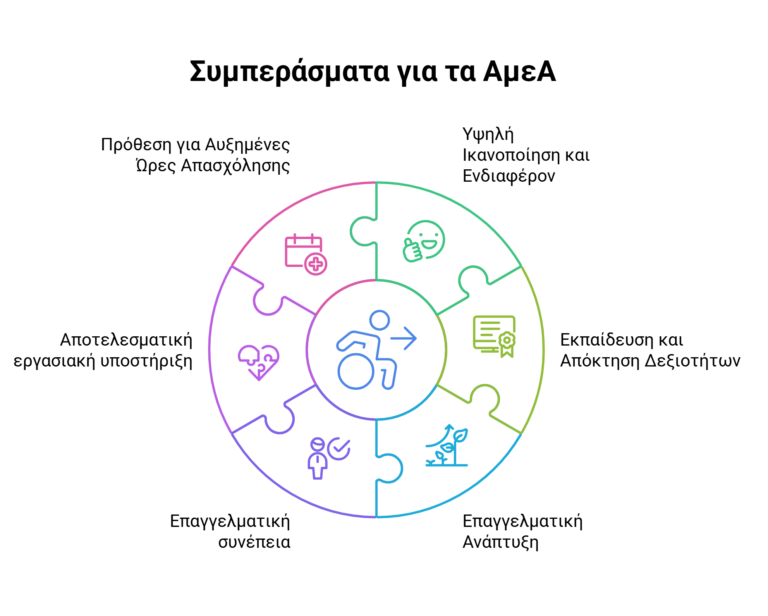
Data collection from educators, participants and parents highlighted multiple benefits. Disabled people were satisfied with the work, support and new skills they acquired, while they saw the program as an opportunity for professional development and strengthening their self-esteem. The trainers appreciated the potential to contribute to an important project while developing their own skills. Parents expressed pride in their children’s participation and acknowledged the importance of the program for their future.
Statements and Perspectives
Operators stressed that the programme bridges the gap between vocational education and the integration of persons with disabilities into the labour market, especially in a sector with great potential such as Artificial Intelligence. They also underlined the importance of technology as a tool for empowerment and social inclusion, noting that innovation can be combined with inclusion and sustainable development. The project is an example of how inter-agency collaboration can create a more inclusive working environment, where the potential of each individual is recognized and exploited to the fullest.
Overall, the project “Disabled Leaders in Artificial Intelligence” opens new avenues for the professional integration of people with disabilities, offering hope, perspective and an active role in a modern and dynamic sector.
See in detail the results of the survey here.
More information about the project can be found here.
View the Video with the impressions of the participants
*Part of the multimedia used was developed with Generative AI
