-
Image
-
Publish in core platform
Yes
-
Link Type
Organization url
-
Digital technology / specialisation
Digital skills Artificial IntelligenceDigital skill level
Basic Intermediate AdvancedGeographic Scope - Country
MaltaType of initiative
Local initiative

Malta Digital Skills and Jobs Platform (LISP)

Executive Summary
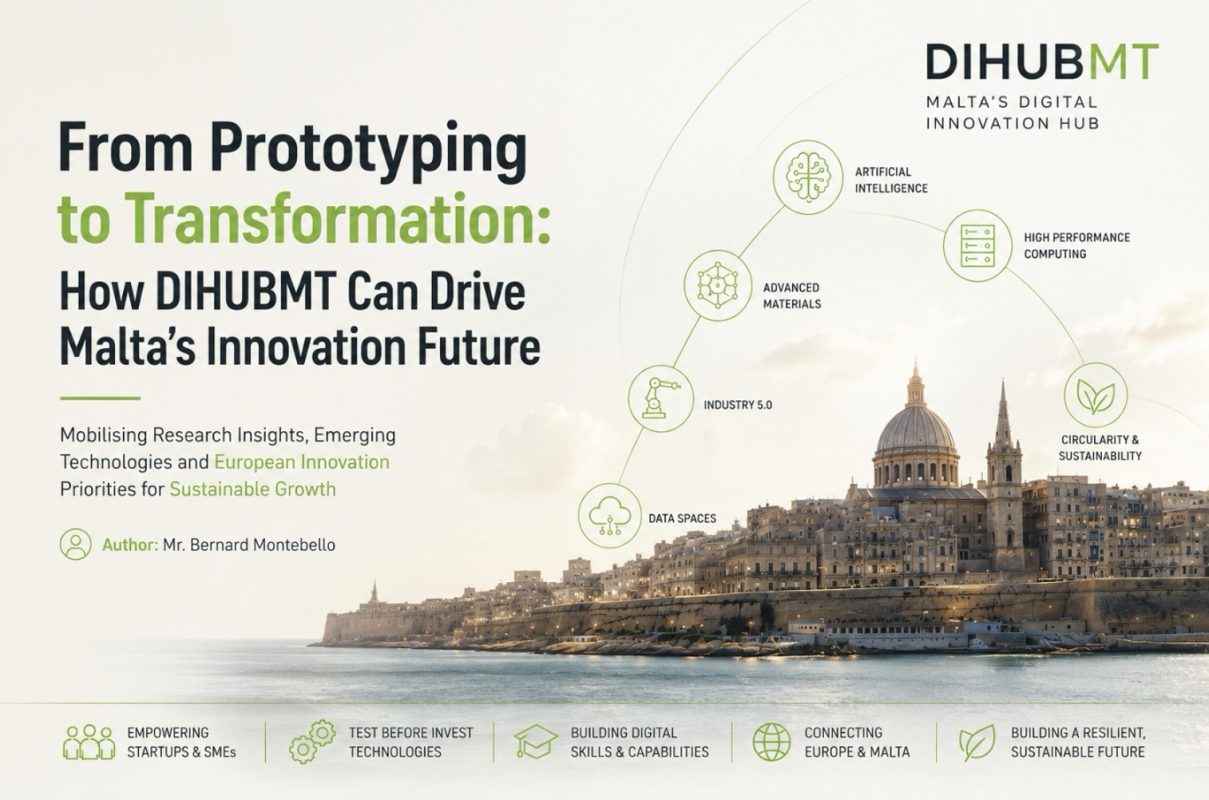
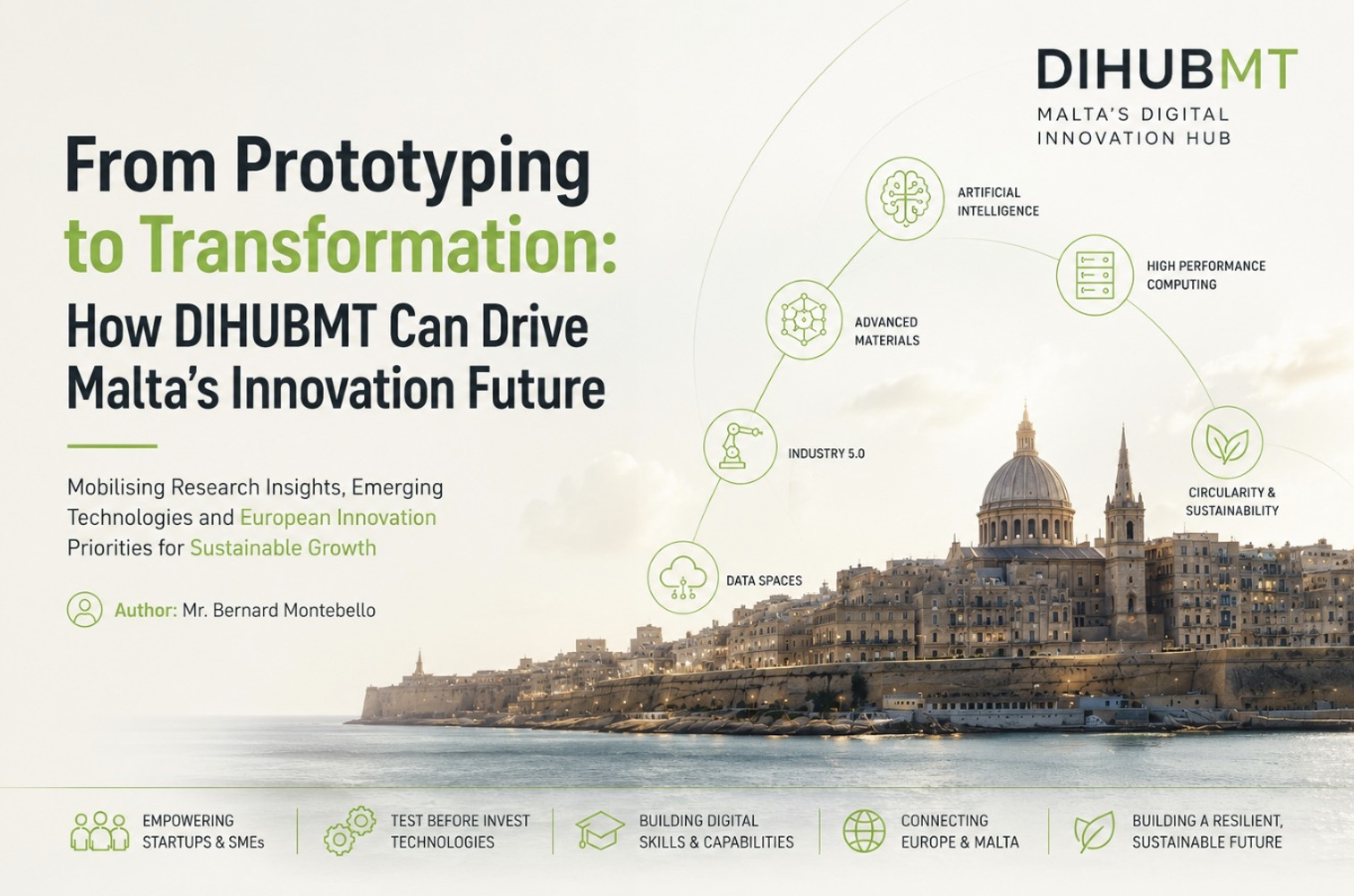
Malta’s Digital Innovation Hub (DIHUBMT) sits at the centre of innovation, technology, industry and public policy. As part of the European Digital Innovation Hubs network, DIHUBMT aims to translate startup ideas into tangible innovations that enhance competitiveness and deliver societal benefits. This thought‑leadership article synthesises insights from recent academic studies on entrepreneurial prototyping and compares them with EU policy documents on artificial intelligence (AI), high‑performance computing (HPC), advanced materials, Industry 5.0, data spaces and circularity. The purpose is to show how DIHUBMT can harness these insights to support Maltese small and medium‑sized enterprises (SMEs), startups and public organisations in their digital and green transformation.
Two core research papers Petrakis et al. (2021) and Paust et al. (2024), highlight that prototyping is central to entrepreneurial success but often misused. Entrepreneurs frequently face funding and skills constraints that force them to adopt skills bricolage relying on existing expertise rather than investing in new skills and to recycle prototypes for multiple purposes. Effective prototypes function as powerful communication and persuasion tools for investors, customers and regulators. A structured, human‑centred prototyping process with clear goals, iterative assessment and explicit attention to stakeholder needs can reduce risk, accelerate learning and improve product‑market fit. Paust et al. warn that misapplied prototyping can create prototyping myopia, where entrepreneurs become trapped in complex prototypes that consume resources without advancing the business. By offering mentorship, prototyping support tools and access to digital technologies, DIHUBMT can help entrepreneurs navigate these trade‑offs.
The article further connects these findings to the European policy landscape. Europe’s Digital Decade aims for a human‑centric, sustainable digital society where everyone has digital skills, high‑quality connectivity and access to digital public services. Horizon Europe’s Cluster 4 and the Digital Europe Programme invest in AI, robotics, advanced materials, HPC and cybersecurity. Malta’s Smart Specialisation Strategy highlights digital technologies as both an innovation sector and an enabler across sectors, but also notes fragmentation, limited research capacity and skills shortages. DIHUBMT must therefore provide test‑before‑invest services, digital skills training, access to HPC and AI experimentation facilities, and a platform for cross‑border collaboration. Future opportunities include establishing advanced materials hubs, AI and data spaces, Industry 5.0 demonstrators and digital twin pilots. Through strategic projects and partnerships, DIHUBMT can catalyse Malta’s transition to a resilient, sustainable and digitally empowered economy.
Introduction
Europe is entering an era defined by profound technological and industrial change. Artificial intelligence, advanced materials, robotics, high-performance computing, digital twins and data-driven manufacturing are no longer emerging concepts confined to research laboratories. They are rapidly becoming the foundations of future competitiveness, influencing how businesses innovate, how governments deliver services and how societies address complex economic and environmental challenges.
At the same time, Europe faces increasing pressure to strengthen its strategic autonomy, improve industrial resilience and accelerate the transition towards a sustainable economy. The European Union’s Digital Decade, the Green Deal and Industry 5.0 initiatives all point towards a future where technological advancement must be accompanied by sustainability, human-centric design and economic inclusivity.
For Malta, these developments present both a challenge and an opportunity. As a small island nation with a strong digital infrastructure, a dynamic entrepreneurial community and an increasingly technology-oriented economy, Malta is well positioned to participate in Europe’s next wave of innovation. However, transforming ambition into impact requires more than policy vision. It requires institutions capable of connecting research, technology, industry and entrepreneurship in practical and meaningful ways.
This is where DIHUBMT plays a critical role.
As Malta’s European Digital Innovation Hub, DIHUBMT is uniquely positioned to become the bridge between emerging technologies and real-world adoption. Its mission is not simply to provide access to digital tools. DihubMT acts as an enabler of transformation, helping startups, SMEs and public organisations understand, test and implement technologies that can improve competitiveness, productivity and sustainability.
The significance of this role is becoming increasingly evident as organisations navigate growing technological complexity. Many businesses recognise the importance of digital transformation but struggle to identify where to begin. Others understand the potential of artificial intelligence, data analytics or automation but lack the resources, expertise or confidence to invest. For startups, the challenge is often even greater, as they must simultaneously develop products, secure funding, validate markets and build operational capabilities.
Recent academic research provides valuable insights into these challenges and highlights why organisations such as DIHUBMT are becoming essential components of modern innovation ecosystems.
Studies examining entrepreneurial prototyping reveal that successful innovation is rarely a linear process. Rather than moving smoothly from idea to market, entrepreneurs continuously experiment, test assumptions, gather feedback and refine solutions. Prototypes serve as learning instruments that help innovators reduce uncertainty before committing significant resources.
Research shows that prototypes are far more than technical demonstrations. They function as communication tools that help entrepreneurs engage investors, customers, regulators and partners. A well-designed prototype can transform an abstract idea into something tangible, enabling stakeholders to visualise opportunities and understand value propositions more clearly.
Research highlights significant barriers. Entrepreneurs frequently operate under financial constraints, limited access to specialised expertise and uncertainty regarding which technologies or methods should be prioritised. They rely heavily on existing skills rather than acquiring new capabilities, a phenomenon researchers describe as “skills bricolage.” While this approach can reduce costs and accelerate development, it can also limit innovation by encouraging entrepreneurs to remain within familiar technological boundaries.
Another common challenge is the tendency to overinvest in prototyping activities without a clear strategic purpose. Researchers have described this phenomenon as “prototyping myopia,” where organisations become absorbed in creating increasingly sophisticated prototypes while losing sight of the underlying business objective. Instead of accelerating innovation, prototyping can become a costly distraction.
These findings have direct implications for DIHUBMT.
The hub’s value lies not only in providing access to technology but also in helping organisations make better innovation decisions. By offering structured guidance, expert mentoring and test-before-invest services, DIHUBMT can help businesses determine when to prototype, what to prototype and how to evaluate success. This reduces risk while ensuring that investments remain aligned with strategic objectives.
The importance of such support becomes even more apparent when viewed within the broader European policy landscape.
Across Europe, governments are investing heavily in artificial intelligence as a strategic technology. AI is increasingly recognised as a general-purpose technology capable of transforming virtually every sector, from healthcare and manufacturing to logistics, education and public administration. The European Union is supporting this transformation through investments in AI infrastructure, data ecosystems, research networks and regulatory frameworks designed to foster trustworthy and human-centric AI.
For Malta, artificial intelligence represents a significant opportunity to strengthen competitiveness across multiple sectors. Successful adoption requires more than access to algorithms and computing power. Organisations must develop practical understanding, establish governance frameworks and build confidence through experimentation.
DIHUBMT can act as the gateway through which Maltese organisations explore these opportunities. Through AI testing environments, demonstration projects and access to specialised expertise, the hub can help businesses move from curiosity to implementation. More importantly, it can ensure that AI adoption remains aligned with ethical principles, regulatory requirements and societal needs.
A similar opportunity exists in the field of high-performance computing and digital twins.
Modern innovation increasingly depends on the ability to simulate, model and predict outcomes before physical implementation. High-performance computing allows researchers and businesses to perform complex analyses at unprecedented scale, while digital twins enable virtual representations of products, systems and environments.
These technologies are transforming industries worldwide. Manufacturers can optimise production processes before making investments. Energy providers can simulate infrastructure performance. Healthcare researchers can accelerate discoveries through advanced modelling. Urban planners can evaluate development scenarios before construction begins.
By providing access to advanced computing resources and expertise, DIHUBMT can democratise these capabilities for Maltese SMEs that would otherwise lack the resources to utilise them. This aligns closely with Europe’s broader ambition to ensure that advanced digital technologies become accessible not only to large corporations but also to smaller organisations that form the backbone of the European economy.
The emergence of Industry 5.0 further reinforces the strategic importance of DIHUBMT.
While Industry 4.0 focused primarily on automation and digitalisation, Industry 5.0 introduces a broader vision centred on human-centricity, sustainability and resilience. The objective is not simply to make production systems more efficient but to create industrial ecosystems that place people, environmental responsibility and long-term resilience at their core.
This evolution is particularly relevant for Malta. As global supply chains become increasingly complex and vulnerable to disruption, smaller economies must identify ways to remain competitive while maintaining flexibility. Industry 5.0 provides a framework for achieving this balance by integrating advanced technologies with human creativity, skills and decision-making.
DIHUBMT can support this transition by creating demonstration environments where businesses can explore collaborative robotics, advanced manufacturing systems, human-machine interaction technologies and sustainable production models. Such initiatives would allow organisations to experiment with future industrial concepts before committing to large-scale investments.
Another emerging area where DIHUBMT can provide significant value is advanced materials innovation.
Around the world, breakthroughs in materials science are enabling new products, improved sustainability and enhanced industrial performance. Advanced materials underpin developments in renewable energy, aerospace, healthcare, electronics and next-generation manufacturing.
Although Malta does not traditionally position itself as a materials science powerhouse, the country has an opportunity to establish itself as a connector between research, innovation and commercialisation. Through partnerships with universities, European research networks and industrial stakeholders, DIHUBMT could facilitate access to advanced materials expertise while supporting businesses interested in exploring new applications and market opportunities.
This approach aligns closely with Europe’s objective of strengthening industrial leadership through innovation and reducing dependence on external technologies and supply chains.
Beyond individual technologies, one of the most important contributions DIHUBMT can make is fostering collaboration.
Innovation rarely occurs in isolation. Successful ecosystems depend on the interaction of entrepreneurs, researchers, investors, policymakers and industry leaders. Malta possesses many of these ingredients, including government agencies, research institutions, private-sector innovators and emerging startups. However, these actors often operate within separate networks, limiting opportunities for collaboration and knowledge exchange.
DIHUBMT can serve as the connective tissue that brings these communities together. By facilitating partnerships, supporting collaborative projects and connecting local organisations with European networks, the hub can help overcome fragmentation and create a more cohesive innovation ecosystem.
This role is particularly important when considering the commercialisation of research.
Across Europe, substantial investments are made in research and development. Yet many promising discoveries fail to reach the market due to gaps between academic research and commercial implementation. Bridging this divide requires specialised support in areas such as intellectual property management, business development, market validation and investment readiness.
As a trusted intermediary, DIHUBMT can help researchers navigate these challenges while connecting them with industry partners capable of transforming knowledge into products and services. Such activities not only generate economic value but also strengthen Malta’s capacity to participate in European research and innovation programmes.
Ultimately, the future success of Malta’s digital transformation will depend on its ability to move beyond technology adoption and towards innovation leadership. This requires institutions capable of reducing barriers, accelerating learning and fostering collaboration across sectors.
DIHUBMT is uniquely positioned to fulfil this role.
By combining access to advanced technologies with expert guidance, training programmes, innovation services and European partnerships, the hub can become a cornerstone of Malta’s innovation ecosystem. It can help startups validate ideas more effectively, enable SMEs to embrace digital transformation with confidence and support public organisations in delivering smarter, more efficient services.
More importantly, it can help ensure that innovation is not viewed as an isolated activity but as a continuous process of experimentation, learning and value creation.
As Europe advances towards a future shaped by artificial intelligence, Industry 5.0, advanced materials, data spaces and sustainable technologies, Malta has an opportunity to position itself as a proactive participant rather than a passive observer. DIHUBMT can be the vehicle through which that ambition is realised, transforming research into innovation, innovation into economic growth and economic growth into long-term societal impact. In doing so, DIHUBMT will not simply support digital transformation. It will help shape Malta’s future as a resilient, competitive and innovation-driven economy at the heart of Europe’s digital decade.
References and Sources
Academic Research
- Petrakis, K., Maia, M., Tzovaras, D., & Moustakas, K. (2021). Prototyping in Entrepreneurial Ventures: Understanding the Role of Skills Bricolage and Resource Constraints. Journal of Entrepreneurship and Innovation Studies.
- Paust, R., Schiffer, M., Möslein, K. M., & Nissen, V. (2024). Avoiding Prototyping Myopia: A Human-Centred Framework for Entrepreneurial Prototyping. International Journal of Innovation Management.
European Union Policy and Strategic Documents
- European Commission. (2021). 2030 Digital Compass: The European Way for the Digital Decade. Brussels: European Commission.
- European Commission. (2022). The Digital Decade Policy Programme 2030. European Union.
- European Commission. (2021). Industry 5.0: Towards a Sustainable, Human-Centric and Resilient European Industry. Directorate-General for Research and Innovation.
- European Commission. (2024). Advanced Materials for Industrial Leadership and Strategic Autonomy. Directorate-General for Research and Innovation.
- European Commission. (2021–2027). Horizon Europe Strategic Plan and Cluster 4: Digital, Industry and Space.
- European Commission. (2021–2027). Digital Europe Programme (DIGITAL).
- European Commission. (2020). A European Strategy for Data.
- European Commission. (2020). White Paper on Artificial Intelligence: A European Approach to Excellence and Trust.
- European Commission. (2024). AI Innovation Package: Supporting Artificial Intelligence Startups and SMEs in Europe.
- European High Performance Computing Joint Undertaking (EuroHPC JU). (2024). EuroHPC Strategic Research and Innovation Agenda.
Malta Policy and Strategy Documents
- Government of Malta. (2021). Smart Specialisation Strategy for Malta 2021–2027 (S3 Malta).
- Malta Digital Innovation Authority (MDIA). National Artificial Intelligence Strategy: Owning AI – A Strategy and Vision for Malta 2030.
- Malta Enterprise. Digitalisation and Innovation Support Initiatives for SMEs.
Additional Background Sources
- European Commission. European Green Deal.
- European Commission. Circular Economy Action Plan.
- European Commission. European Digital Innovation Hubs (EDIH) Network Framework and Guidelines.
- European Commission. Digital Europe Programme Work Programmes 2025–2027.
- European Commission. European Research Area (ERA) Policy Agenda and Innovation Ecosystem Initiatives.
Editorial Disclaimer
This document was prepared with the assistance of generative AI tools for editorial support (e.g., language refinement and drafting suggestions). Any AI-generated suggestions were reviewed, edited, and validated by the authors, who remain fully responsible for the final content. Where relevant, AI tools were also used to develop illustrative concepts and image-generation prompts; final selection and inclusion decisions were made by the authors and the publisher.
This article is based on information gathered from various online sources and intended only for informational purposes. It does not constitute professional advice or recommendations. While the information provided is accurate and true to the best of our knowledge, we make no representations or warranties of any kind, express or implied, regarding the completeness, accuracy, reliability, suitability, or availability of the topics covered. We strongly advise readers to conduct further research and consult appropriate professionals or experts before making any decisions based on the information presented in this article.
We disclaim any liability for losses or damages incurred based on the information provided herein