-
Image
-
Publish in core platform
No
-
URL
-
Link text
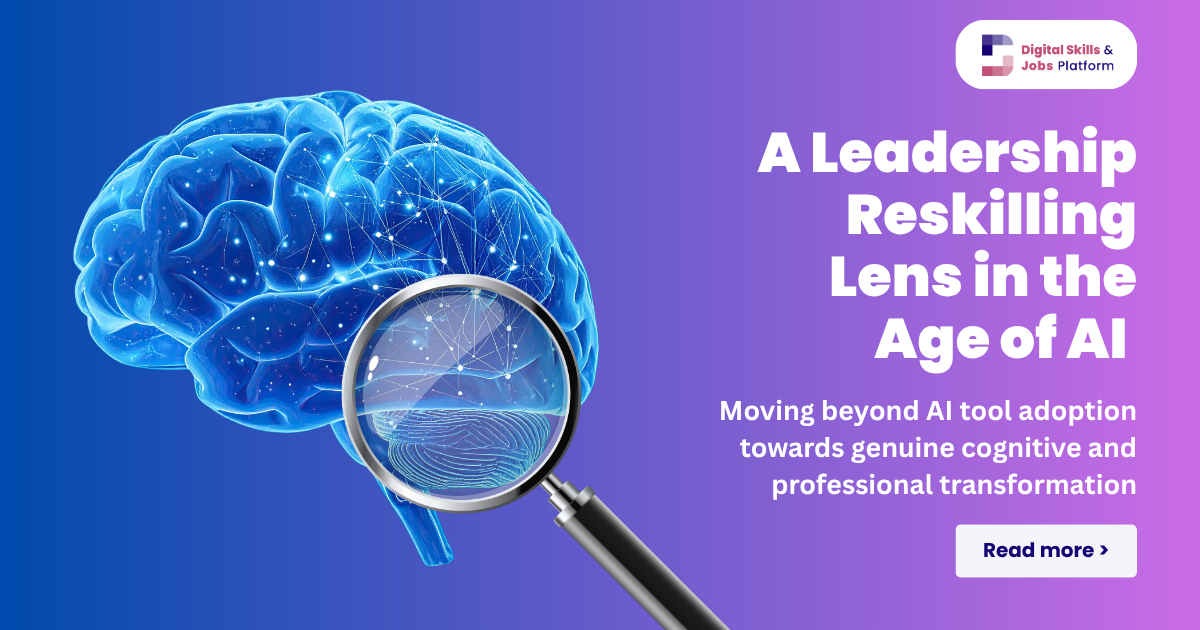
AI & Leadership Reskilling Lens deep-dive
-
Link Type
Background information url
-
Target audience
Digital technology / specialisation
Artificial IntelligenceDigital skill level
AdvancedGeographic Scope - Country
European UnionIndustry - Field of Education and Training
Target language
Type of initiative
EU institutional initiative
Event setting
 Experts call for a new approach to Neuro-AI governance October 27, 2026
 The important role of AI ethics specialists October 15, 2026

 Minecraft Education Challenge October 5, 2026Skip to content

Malta Digital Skills and Jobs Platform (LISP)

European organisations are adopting AI at speed, yet adoption and realised value are pulling apart: pilots stall, initiatives are abandoned, and the EU’s own skills targets are off-track. This brief argues, and tests against the evidence, that the decisive reskilling task for leaders is not mastering tools but learning to think and work differently with AI: choosing augmentation over automation, intentionality before efficiency, and the deliberate preservation of human judgment.
Drawing on EU institutional data, peer-reviewed research, and organisational cases from across Europe, it distinguishes automation (removing people from the loop) from augmentation (extending what people can do, with judgment still central) and locates the binding constraint not in technology but in cognition and professional capability at the leadership layer. It defines that capability concretely, discernment, metacognition, intentionality, examines the deskilling risk of unreflective AI use, and steelmans the opposing case that tool adoption alone suffices, before showing where it breaks down.
The argument extends EU strategy rather than contradicting it: competent human oversight is a precondition for trustworthy AI, not an add-on. For leaders, HR and L&D functions, and policymakers, the practical shift is to measure transformation, whether an organisation does genuinely new things, rather than adoption alone.
Keywords
#Leadership reskilling | #Cognitive transformation | #Augmentation | #AI governance | #Responsible AI
The adoption gap
European organisations are adopting artificial intelligence (AI) at speed. The share of EU enterprises using AI rose from 8.1% in 2023 to 13.5% in 2024 and 20.0% in 2025 (Eurostat, 2025). Adoption is real and accelerating, but uneven, around 55% of large firms against roughly 16% of small and medium-sized enterprises.
What adoption has not reliably produced is value. Massachusetts Institute of Technology (MIT)’s analysis of three hundred public AI deployments found that 95% of generative-AI pilots delivered no measurable impact on the income statement (MIT NANDA, 2025). The pattern is not confined to pilots. Across more than a thousand enterprises in North America and Europe, the share abandoning most of their AI initiatives before production rose from 17% in 2024 to 42% in 2025 (S&P Global, 2025). Adoption is rising; the conversion of adoption into outcomes is, if anything, getting harder.
This gap has a public counterpart. The State of the Digital Decade 2026 reports that the EU’s basic digital skills target is off-track, around 60% of adults at the required level today, against an 80% goal for 2030. Information and Communication Technology (ICT) specialists number roughly 10.5 million, just over half of the 20 million target (European Commission, 2026).
This brief argues, and tests against the evidence, that the decisive reskilling task for leaders is not mastering tools but learning to think and work differently with AI: choosing augmentation over automation, intentionality before efficiency, and the deliberate preservation of human judgment. This is a hypothesis to be supported, qualified, and counter-argued – not a conclusion to assert.
One distinction carries the argument throughout. Automation uses AI to streamline existing processes and remove people from the loop. It delivers real short-term gains but optimises today’s process, and sometimes yesterday’s assumptions, and can breed dependency. Augmentation uses AI to extend what people can do, with human judgment still central. It requires new cognitive capabilities and the deliberate design of how work is divided between human and machine. The lens here is leadership and organisational, not individual.
Why doesn’t adopting AI tools deliver the transformation organisations expect?
The failure recorded in those numbers is not a failure of the technology. It is a failure to convert a tool into a capability, and the gap between the two is wider than the ease of adoption suggests.
Begin with what adoption actually requires. Beneath the visible act of deploying a tool sits a precondition most organisations underestimate: readiness, based on the data infrastructure, the baseline digital literacy, and process maturity without which a model has nothing reliable to work on. Above that precondition, value accrues across three layers. The first is tool access: licences, accounts, an AI system staff can access. The second is workflow integration: the tool embedded in how work is actually done, with processes redesigned around it. The third is cognitive and cultural change: people and teams thinking differently about what to delegate, what to keep, and how to judge what the system returns. Adoption clears the first layer. The return lives in the second and third.
The evidence is consistent on this, and it is not that AI fails to work. Causal estimates from the European Investment Bank, drawn from more than 12,000 European and US firms, find that AI adoption does raise labour productivity, by roughly 4% on average. But the gain hinges on complementary investment, and the complements are not interchangeable: a percentage point spent on workforce training amplifies AI’s productivity effect more than twice as much as the same spend on software or data (Aldasoro et al., 2026). The Organisation for Economic Cooperation and Development (OECD) reaches the same conclusion from the policy side: across G7 economies, AI’s productivity returns depend on complementary investment and on integrating the system into how the business actually operates, not on the tool alone (OECD, 2025). The tool and the complements are not separable inputs to be added in any order; they are a single capability. An organisation that buys the first while skipping the second has not bought a smaller share of the value, it has bought an expense.
This is why the low barrier to adoption is itself a trap. Deploying a tool is trivial; realising its value is deep, demanding work. That asymmetry tempts organisations to treat the tool as the deliverable and the harder work as optional. The result is both resistance to change and a quiet drift toward automation. Optimising the current process is simply the path of least resistance when the deeper work is skipped.
That drift also narrows the scope of what AI is used for. Confined to optimising what already exists, AI is set to work on the most over-engineered, lowest-headroom parts of the operation. The larger possibility, using it to do things the organisation could not do before, never enters the plan. This is the imagination gap: not too few tools, but too little sense of what they could be used for. It is a leadership problem before it is a technical one, and it recurs through everything that follows.
This leaves one question. The missing complement is not the tool, and it is not another prompting class. So, what is it that organisations should be building instead?
Reskilling for what, exactly? From tool proficiency to cognitive capability
The answer is not more tool training. Knowing how to operate an AI system; how to prompt it and which buttons to press, is a necessary skill and one that is quickly learned. But it is not what the evidence above is pointing to. The missing capability is a different order of thing: the ability to think with AI, rather than merely use it.
That ability has identifiable components. The first is discernment: evaluating what a system returns rather than accepting it, recognising when a fluent answer is wrong. The second is metacognition, the capacity to understand how one’s own reasoning works and to develop it. Used deliberately, AI becomes a cognitive mirror: it externalises a line of reasoning so a person can see, test and sharpen their own. The human, in turn, refines the machine’s; a two-way loop in which each party’s thinking improves the other’s. The third is intentionality: knowing why one is using AI and what for, and deciding what must remain human, and what to augment and how.

The distinction is not merely conceptual. In a controlled study, access to a strong AI assistant improved performance while it was available but left users weaker once it was withdrawn. The harm largely disappeared only when the system was deliberately designed to keep them thinking (Bastani et al., 2025). Assisted output can mask an erosion of the underlying capability, which is why the reskilling target must be the capability itself, not the assisted result. Independent labour-market analysis points the same way: employers now rank analytical thinking as the most-needed core skill, ahead of any specific technical proficiency (WEF, 2025).
There are two directions of travel here. AI use can drive cognitive deskilling, the quiet atrophy of judgment that follows when the system does the thinking, the signature of automation. It can also provide cognitive scaffolding: it extends and strengthens human judgment, the signature of augmentation. The same tool can do either. Which one it does is a design choice, not a property of the technology.
A broader idea is taking shape across research and practice: that working well with AI is itself a distinct, measurable human capability. Researchers have begun to formalise an Artificial Intelligence Quotient, an individual’s capacity to collaborate with AI, statistically distinct from IQ and from AI literacy (Qin et al., 2025). In my own work, I have argued that this capacity is not only analytical. At Homo Promptus, we frame it as a Hybrid Quotient: the pairing of an augmented IQ with an augmented EQ, the human capacities for consciousness, empathy, and the intentional guidance of an intelligent system. On this view, hybrid intelligence emerges only when human judgment and machine generation enter a fluid, iterative collaboration that produces outcomes neither could reach alone (Allegra, 2026).
There is a regulatory echo here. The AI Act requires those deploying AI to have sufficient literacy to oversee it (European Commission, 2024, Article 4). The Act’s aim is trustworthy AI, and competent human oversight is not a side obligation to that aim but a precondition for it. If the people accountable for a system cannot judge its output, “trustworthy AI” is unreachable in practice, whatever the compliance file says. The capability is also contextual: a hospital director or a non-technical chief executive needs the judgment to govern AI, not the skill to build it, which is precisely why this sits at the leadership layer. Whether that judgment is built or allowed to wither turns on a single choice.
Automation or augmentation: which one keeps people thinking?
The choice is whether AI is used to automate the work or to augment the worker. Most organisations make it without realising a choice is being made at all. Automation removes the human from the loop, and with them the occasion to exercise judgment. Augmentation keeps judgment central and uses AI to extend its reach. Under efficiency pressure the default drifts toward automation, because on a cost line, removing a step is the legible win.
Augmentation sounds clearly preferable. But choosing it is not enough: even keeping a human in the loop does not, on its own, guarantee a better result. The evidence cautions against assuming that simply combining humans and AI captures the best of both. A meta-analysis of 106 studies found that, on average, human–AI combinations performed worse than the better of the human or the AI alone, with the losses concentrated in decision-making tasks. (Vaccaro, Almaatouq & Malone, 2024). That is exactly where leadership lives, which makes the finding easy to misread as an argument against keeping humans involved. It is the opposite. What it shows is that naive combination fails, placing a human beside a model and hoping for synergy does not work. The failure is not that AI is too weak or the human redundant; it is that the collaboration is badly designed. “Human-in-the-loop” is not a guarantee; it is a design problem.
Several forces push that design toward failure. The first is the human tendency to offload effort, to hand memory, calculation, and ultimately judgment to whatever external system will take them. This is well documented, and not in itself a flaw: offloading is adaptive, and can free attention for higher-order work (Risko & Gilbert, 2016). But AI makes it frictionless and ubiquitous, removing the small cognitive frictions that previously forced reflection, and reflection is where capability is maintained. The second force is overtrust: as outputs grow more fluent and better contextualised, the critical guard drops and fluency starts to read as proof. The third is the seduction of the early win, adoption is easy and the first efficiency gains arrive fast, which creates the impression that transformation is equally easy, when in fact adoption maturity and collaboration maturity are entirely different things.
None of this makes deskilling inevitable. The same study found unaided performance suffered after unguarded AI use, but that a version designed with appropriate friction largely removed the harm (Bastani et al., 2025). Deskilling is real but design-contingent, a function of how the tool is built and used, not an automatic effect of AI. The counter-evidence is live too: well-designed systems can scaffold learning and spread expert practice. The honest position is that this is emerging and unsettled, not a settled verdict.
What the evidence does support is narrow and firm: whether AI use builds capability or erodes it depends on deliberate design, not on adoption. Scaffolding has to be engineered; deskilling is what happens by default. Which raises the strongest objection to everything argued so far. If augmentation demands this much; design, judgment, reskilling, perhaps it is not worth the cost. Perhaps, for most work, simply adopting the tools delivers most of the value, and the cognitive lens is an expensive answer to a problem most organisations do not have.
Isn’t tool adoption enough? The case against a cognitive lens
The objection deserves a serious answer. The strongest case for tool adoption being sufficient rests on real, current gains. Deploying a generative-AI assistant in a customer-support setting raised worker productivity by around 14% on average, with the largest gains among less-experienced staff (Brynjolfsson, Li & Raymond, 2025). Early enterprise surveys point the same way: most firms adopting AI in finance and manufacturing reported improved productivity and little change in employment (OECD, 2023). Hand people a capable tool, and measured output rises. If that holds, a demanding programme of cognitive reskilling looks like an expensive solution to a problem the numbers do not show.
The case is real. It is also short-sighted, in the precise sense that it mistakes an early reading for a durable one. The gains are largest on bounded, routine work and among novices, the tool substitutes for experience the organisation has not yet built. And the early bump can decay as it is booked. A 2025 BetterUp/Stanford survey found that 41% of workers had received AI-generated “workslop”, output that looks finished but lacks substance, in the previous month, each instance costing nearly two hours to correct (Niederhoffer et al., 2025). Work that registers as a productivity gain for the sender becomes rework for the receiver; the efficiency is partly an accounting illusion, shifted downstream rather than created.
The most ambitious version is institutional: McKinsey estimates automation could unlock up to $1.9 trillion across Europe by 2030 (McKinsey Global Institute, 2026). Yet its own classification undercuts the headline: most European employment stays people-centric or hybrid, and around three-quarters of sought-after skills will be applied in collaboration with AI, not replaced by it. Where value depends on human judgment, that is augmentation, not automation.
This is why measurement is the heart of the matter. Automation and augmentation diverge over time: automation ramps fast and then flattens as capability erodes and talent leaves, while augmentation invests deeper, ramps slower, and compounds (De Neve, Hancock & Niederhoffer, 2026). Efficiency metrics like OPEX reduction and short-run Return of Investment (ROI), capture the early bump and are blind to the downstream cost, the attrition, and the capability not built.
During a transformation, leaders need to watch different instruments: return on intention, collaboration performance, the rate at which the organisation does genuinely new things. The pro-tool case wins the quarter on the wrong scorecard and loses the year.
So, the steelman holds where it claims to and stops where it overreaches. On the most over-engineered routine tasks, automation is simply the right call, and reskilling would be waste. The failure is not automation itself. It is automation hardening from a tactic into the default posture, the reflexive answer to every problem, then the operating strategy, then the mindset. At that point it does not merely leave the imagination gap unaddressed; it widens it. The same research finds the cost is already visible: 81% of senior leaders believe their strategy is augmentation, but only 53% of their own frontline staff see it that way, and 40% suspect the real intent is automation (De Neve, Hancock & Niederhoffer, 2026). An organisation that reaches for automation everywhere stops asking what augmentation might have made possible, and its own people notice first.
What helps – and what hinders – genuine transformation?
If the constraint is cognitive and organisational rather than technical, the practical question follows: what actually builds the capability, and what blocks it?
Start with where the effort should go. BCG’s analysis of AI transformations gives a striking allocation; the organisations that capture value follow what it calls the 10–20–70 rule: roughly 10% of the effort on algorithms, 20% on technology and data, and 70% on people and processes (BCG, 2025). The implication is uncomfortable for a procurement-led approach: most of the work, and most of the return, lies in the part that cannot be bought. Yet this is precisely the part organisations skimp. The European Company Survey found that only 9% of EU establishments offer comprehensive training and learning, and only around 20% qualify as “high-involvement” workplaces that combine training with autonomy and participation (Eurofound and Cedefop, 2020). Europe’s weakness is not the absence of training; it is that too few organisations do it in the way that builds capability.
Several conditions distinguish those that do. The first is leaders modelling intentional use, visibly reasoning with AI rather than mandating it, since, as the perception evidence in the previous section showed, staff read daily behaviour more than strategy decks. The second is L&D redesigned around capability, not tool proficiency: training that develops discernment and judgment, not another prompting course. The third is psychological safety, the freedom to challenge an AI output without penalty. Decades of research establish that psychological safety predicts whether teams actually learn and adopt new practice (Edmondson, 1999); without it, people defer to the confident machine rather than question it, and discernment never forms. The fourth is explicit human-in-the-loop design and protected time for reflection, the deliberate friction previously identified as the difference between scaffolding and deskilling.
There is also a structural pattern worth naming: the work splits across two leadership tiers. Executives set the intentionality, what the organisation uses AI for and what it deliberately keeps human, while middle managers operationalise it in the daily decisions where staff actually read the signal. When the two tiers diverge, the perception gap opens; when they align, augmentation becomes credible.
That capability is real and measurable where organisations commit to it. Capgemini reported an average of 97 learning hours per employee in 2025, above its own 70-hour target, with 120,000 employees upskilled specifically in generative-AI methods (Capgemini, 2026), a scale of deliberate investment that the augmentation path requires and the automation path never reaches.
What hinders is, in each case, the mirror image. Efficiency-only metrics measure the early bump and miss the erosion. Hype-driven adoption, buying the tool because rivals have it, with no conception of what it is for, which is the imagination gap operating at the level of strategy. Compliance-theatre ethics, where AI governance is a document rather than a practised judgment. And one-off training, the workshop that ticks a box and changes nothing, which is exactly the training the European Company Survey found most organisations rely on. The pattern is consistent: transformation fails not where organisations invest too little in tools, but where they invest too little in people.
Reskilling leadership as a cognitive act, what it means for EU skills policy
The evidence assembled here converges on a single claim. At the level of tool access, AI is diffusing fast. But at the level that matters, the judgment where leadership operates, the constraint is not technical but cognitive and professional. The organisations that capture value are not those with the best tools, but those that build the capability to think with them. That capability is concrete: discernment, metacognition, intentionality, and the deliberate design of the human–machine division of labour.
Three independent vantage points reach the same conclusion. Labour-market analysis puts analytical thinking, not any technical proficiency, at the top of the skills employers most need (WEF, 2025). The EU’s own monitoring shows the skills frame is not keeping pace: the basic-skills target is now off-track, projected to be met around 2037 rather than 2030 (European Commission, 2026). And the AI Act’s logic points the same way: competent human oversight is the precondition for trustworthy AI, not an add-on to it (European Parliament and Council, 2024). When policy design, independent evidence, and the Union’s own data agree, the signal is worth heeding.
This argument extends EU strategy rather than contradicting it. The AI Continent Action Plan and the Union of Skills already frame capability as Europe’s competitive foundation (European Commission, 2025a, 2025b). The contribution here is to specify what that capability is at the leadership layer, and to propose a shift in how success is judged: measuring transformation, whether the organisation does genuinely new things, rather than adoption, the mere presence of a tool.
The reskilling task for leadership is, in the end, a cognitive one. Europe does not lack AI tools, nor the ambition to deploy them. What it must now build is the capacity, and the leadership judgment, to use them for augmentation rather than automation.
Further details
Check out the full version of this deep-dive, together with its references and infographics, via this link.
Author’s biography
Henri Allegra works at the intersection of cognitive transformation, responsible AI governance, and intentional leadership, helping organisations move from passive AI adoption to deliberate, human-centred AI strategy. He is founder of Homo Promptus, a cognitive and AI leadership transformation programme for business investors, business leaders and their teams. He is also the founder and president of Etikord, a consulting venture dedicated to responsible and ethical business, both grounded in the conviction that human-centred, responsible practice is the foundation of lasting organisational performance. He brings more than twenty-five years of international corporate leadership across LinkedIn, Universum, Mintel and Forrester Research in Europe and Asia, building and leading consulting and sales teams, delivering executive-level advisory, and developing senior relationships with Fortune 500 and large-cap organisations.