-
Image
-
Publish in core platform
Yes
-
Link Type
Organization url
-
Digital technology / specialisation
Artificial Intelligence Digital skillsDigital skill level
Basic Intermediate AdvancedGeographic Scope - Country
MaltaType of initiative
Local initiative

Malta Digital Skills and Jobs Platform (LISP)

Abstract
In February 2025, a 185-word social media post by AI researcher Andrej Karpathy introduced a phrase that would become Collins Dictionary’s Word of the Year and reshape the conversation about who can build software. Vibe coding — describing what you want in plain language and letting an AI generate the code — has lowered the barrier to software creation in ways that matter beyond the technology sector. This article examines what vibe coding actually is, how it has evolved in the eighteen months since it was named, and why the shift from writing code to directing AI agents is a development that workers, employers, and policymakers across all sectors need to understand.
Introduction
Most people who work outside the technology sector have a mental model of software development that involves long hours, obscure programming languages, and expertise acquired over years of formal training. That model is not wrong — professional software engineering remains a highly skilled discipline. But it is increasingly incomplete, because a new category of software creation has emerged that operates on different terms entirely.
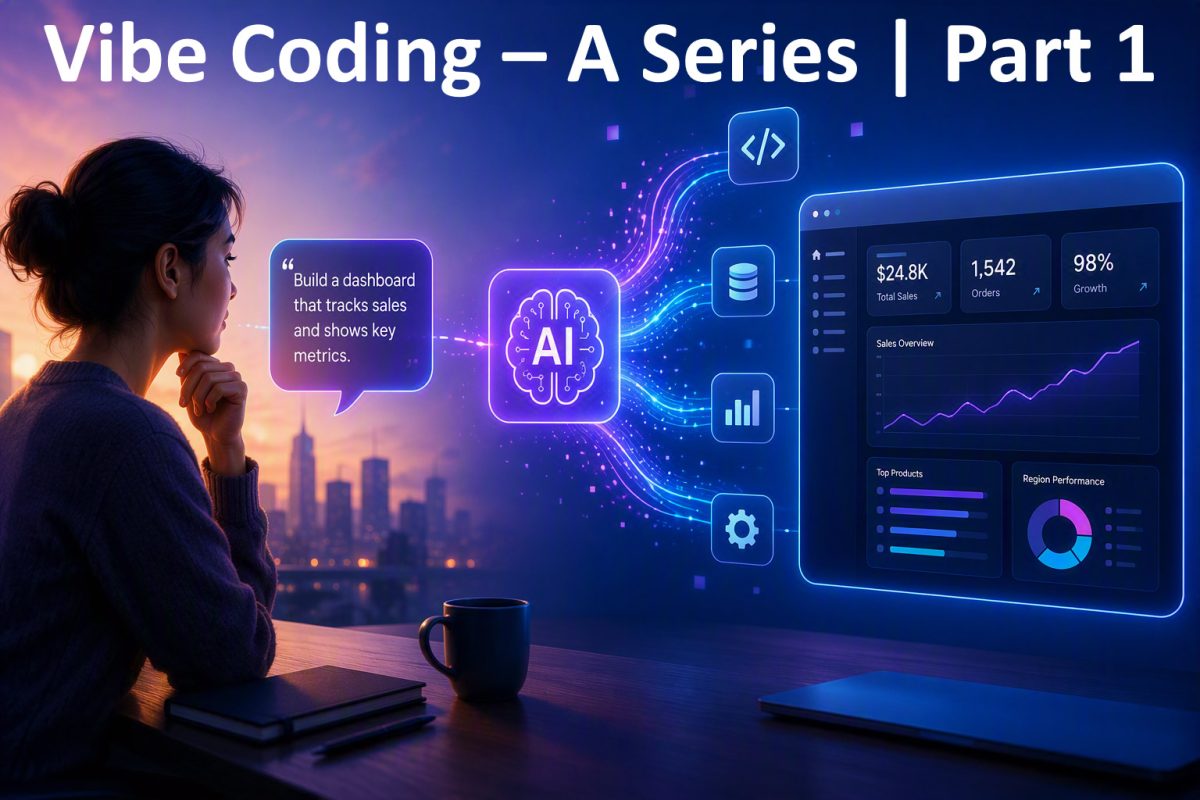
Vibe coding is the practice of building software by describing intent in natural language and letting AI tools generate, refactor, and iterate on the code. The term was coined in February 2025 by computer scientist Andrej Karpathy, a co-founder of OpenAI and former AI leader at Tesla, and was named the Collins English Dictionary Word of the Year for 2025. Its significance is not simply that it gave developers a new way to work faster. It is that it began dissolving the boundary between people who can build software and people who cannot.
A Tweet That Named a Moment
In February 2025, Andrej Karpathy dropped a tweet-sized cultural marker into the software world. Instead of grinding through syntax, you describe an intent in plain English, watch the code manifest, and nudge the output until reality matches your vision. Karpathy framed it as engineering where you “fully give in to the vibes, embrace exponentials, and forget that the code even exists.”
The phrase stuck because it captured a visceral shift in the developer experience. Karpathy’s point was not just that AI could help you code — AI coding assistants had existed for years. The point was that AI made it tempting to treat code as a steerable draft rather than something requiring line-by-line authorship.
Merriam-Webster listed the term in March 2025 as a “slang and trending” expression. Advocates say it allows even amateur programmers to produce software without the extensive training required for software engineering. Critics point out a lack of accountability, maintainability, and an increased risk of security vulnerabilities. Both observations are correct. The tools work. The risks are real. The gap between them is where the interesting questions live.
The Scale of Adoption
The adoption figures are striking. By 2026, surveys indicate that 92% of US-based developers use some form of AI coding assistance in their workflow. The AI coding market is growing at 38% compound annual growth rate, outpacing traditional developer tools at 16%. Cursor went from one billion to two billion dollars in annual recurring revenue in three months. Average AI coding startup deal sizes surged 71 times — from $7.4 million in 2022 to $527.8 million by end of 2025.
More significant than the investment figures is what is happening inside organisations. A quarter of startups in Y Combinator’s current cohort have codebases that are almost entirely AI-generated. TELUS saved 500,000 hours with 13,000 AI solutions. Zapier hit 89% AI adoption across their entire organisation. Stripe’s AI agents produce more than 1,000 merged code contributions per week. These are not experimental deployments — they are production workflows at scale.
Beyond Developers: The Non-Technical Builder
The more consequential shift may not be happening among professional developers at all. Research by the Nielsen Norman Group examined how non-technical workers are using agentic AI tools to build working systems. Their study found nontechnical people building complex agentic AI systems on intuition developed through hours of experimentation, YouTube videos, and community forums. Participants included a product designer at a financial institution building personal software tools on evenings and weekends; a marketing startup founder running a headless orchestration system with proactive suggestions and multiagent coordination; and a head of product who put his entire team on a Claude-based system that replaced meetings, shared information, and facilitated decision-making — all without a technical background.
The Nielsen Norman Group called these individuals “vibe architects” — people applying vibe coding not just to build individual tools but to redesign how information flows across systems and how work gets done, sometimes for entire teams. The label is revealing. It suggests that the most significant skill in this new environment is not coding competence but systems thinking: the ability to understand what a process should do, decompose it clearly, and direct AI tools to implement it.
From Vibe Coding to Agentic Engineering
The original conception of vibe coding — accepting all AI output without review, letting the codebase grow beyond comprehension — was always better suited to weekend experiments than to production software. By early 2026, the limitations had become apparent enough that Karpathy himself reframed the concept.
In February 2026, Karpathy noted that LLMs have gotten much smarter, such that the original conception of vibe coding is now passé. “Today, programming via LLM agents is increasingly becoming a default workflow for professionals, except with more oversight and scrutiny,” he wrote. “The goal is to claim the leverage from the use of agents but without any compromise on the quality of the software.” His preferred term for this evolution: “agentic engineering.”
The name signals a dual commitment. “Agentic” acknowledges that for 99% of the work, you are not writing the code directly — you are orchestrating agents that do. “Engineering” emphasises that this is a discipline requiring expertise, structure, and science. It is not a slot machine; it is a skill you can refine and master.
The distinction matters for anyone thinking about what these tools mean for their career or organisation. Vibe coding at its most casual — accepting AI output without review, skipping testing, treating prototypes as production software — carries real risks. Agentic engineering, which applies structured oversight to AI-generated code, is increasingly how professional organisations are capturing the speed benefits while managing the quality and security trade-offs.
What This Means for Skills
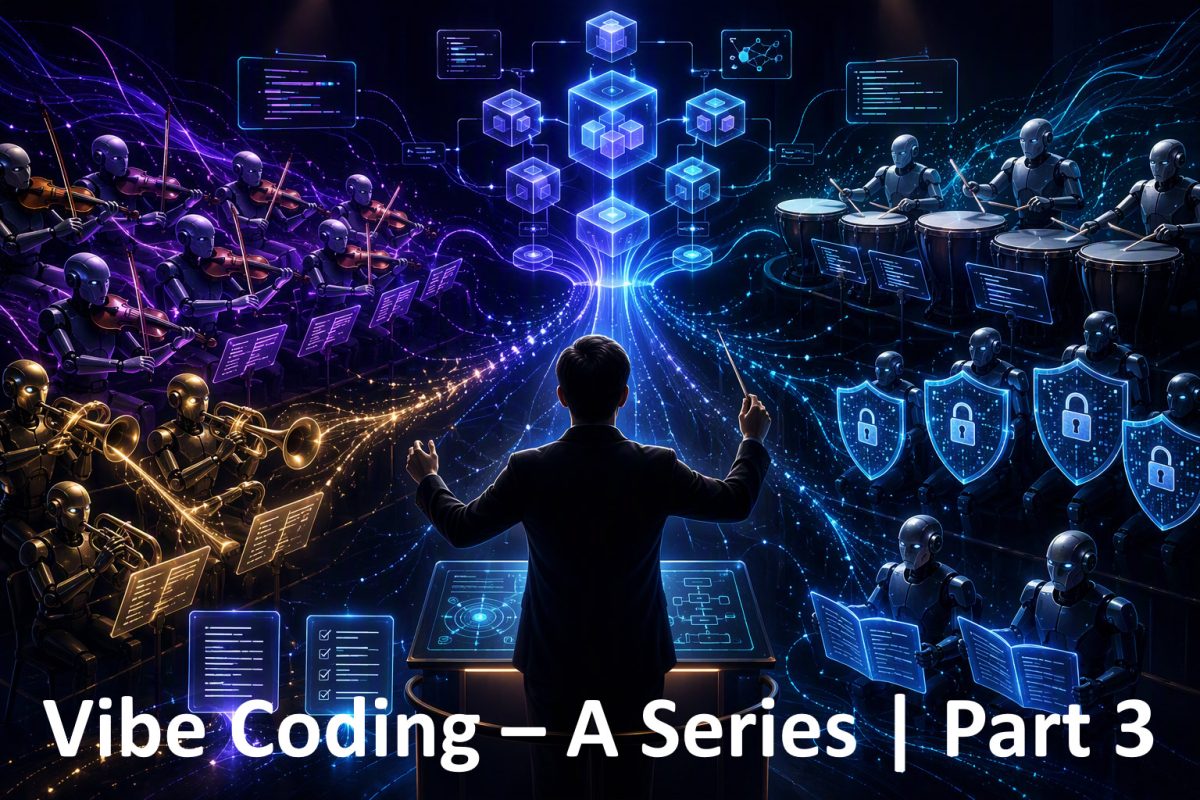
Gartner projects 40% of enterprise applications will integrate autonomous AI agents by end of 2026, up from under 5% in early 2025. Forrester describes the shift as engineers becoming “AI Conductors,” focused on workflow orchestration and architectural validation.
The European Commission’s Digital Competence Framework DigComp 2.2 identifies five core competence areas: information and data literacy, communication and collaboration, digital content creation, safety, and problem-solving. Its most recent update specifically expanded the framework’s treatment of AI literacy and human oversight of automated systems — recognising that interacting competently with AI tools is now a component of digital competence for citizens across all roles, not only technical ones. Vibe coding, and the agentic engineering it is evolving into, makes those competencies directly generative: the ability to specify clearly, evaluate critically, and maintain accountability for AI outputs is the practical expression of digital competence in an environment where AI can produce working software from plain language instructions.
The boundary between “people who can build software” and “people who cannot” is not disappearing. But it is moving — and for professionals willing to develop the skills of clear specification, critical evaluation, and structured oversight of AI outputs, it is moving in a useful direction.
References
- Wikipedia, Vibe Coding, July 2026. https://en.wikipedia.org/wiki/Vibe_coding
- IBM, What is Vibe Coding?, 2026. https://www.ibm.com/think/topics/vibe-coding
- Klover AI, Andrej Karpathy Vibe Coding, June 2025. https://www.klover.ai/andrej-karpathy-vibe-coding/
- Google Cloud, Vibe Coding Explained: Tools and Guides, 2026. https://cloud.google.com/discover/what-is-vibe-coding
- Simon Willison, Not All AI-Assisted Programming Is Vibe Coding (But Vibe Coding Rocks), March 2025. https://simonwillison.net/2025/Mar/19/vibe-coding/
- CodeRabbit, A Semantic History: How the Term Vibe Coding Went from a Tweet to Prod, March 2026. https://www.coderabbit.ai/blog/a-semantic-history-how-the-term-vibe-coding-went-from-a-tweet-to-prod
- The New Stack, Vibe Coding Is Passé. Karpathy Has a New Name for the Future of Software, February 2026. https://thenewstack.io/vibe-coding-is-passe/
- Nielsen Norman Group, Vibe Architects: Agentic Vibe Coders, June 2026. https://www.nngroup.com/articles/vibe-architects/
- Keyhole Software, Vibe Coding Trends 2026: Adoption, Productivity, and Code Quality Data, June 2026. https://keyholesoftware.com/vibe-coding-trends-2026/
- Turing College, Agentic Engineering vs. Vibe Coding, 2026. https://www.turingcollege.com/blog/agentic-engineering-vs-vibe-coding
- DEV Community / Jason Guo, From Vibe Coding to Agentic Engineering, February 2026. https://dev.to/jasonguo/from-vibe-coding-to-agentic-engineering-when-coding-becomes-orchestrating-agents-1b0n
- Vibecademy, Learn Vibe Coding in 2026: The Complete Guide, May 2026. https://www.vibecademy.ai/blog/learn-vibe-coding-2026
- European Commission / Joint Research Centre, DigComp 2.2: The Digital Competence Framework for Citizens, 2022. https://publications.jrc.ec.europa.eu/repository/handle/JRC128415
- Gartner Research: https://www.gartner.com/en/newsroom/press-releases/2025-08-26-gartner-predicts-40-percent-of-enterprise-apps-will-feature-task-specific-ai-agents-by-2026-up-from-less-than-5-percent-in-2025
This article is based on information gathered from various online sources and intended only for informational purposes. It does not constitute professional advice or recommendations. While the information provided is accurate and true to the best of our knowledge, we make no representations or warranties of any kind, express or implied, regarding the completeness, accuracy, reliability, suitability, or availability of the topics covered. We strongly advise readers to conduct further research and consult appropriate professionals or experts before making any decisions based on the information presented in this article.
We disclaim any liability for losses or damages incurred based on the information provided herein.
This document was prepared with the assistance of generative AI tools for editorial support and image generation. Any AI-generated suggestions were reviewed, edited, and validated by the authors, who remain fully responsible for the final content.